



back to News
From Hijuelas to the United States — the Chilean nursery making its mark in the Silicon Valley of Biotechnology
August 10, 2026

[DF MAS article]
It was a closed-door deal. The seller: Progress Center Office Development. The buyer: Inversiones San Marcos LLC, a company incorporated by Chilean group Hijuelas just days before the transaction closed. The assets involved: two properties within Progress Park, a 320-hectare district in Alachua, north of Gainesville, Florida, home to offices, laboratories and manufacturing centers for biotechnology and pharmaceutical companies. Some describe it as the biotechnology Silicon Valley of the U.S. East Coast.
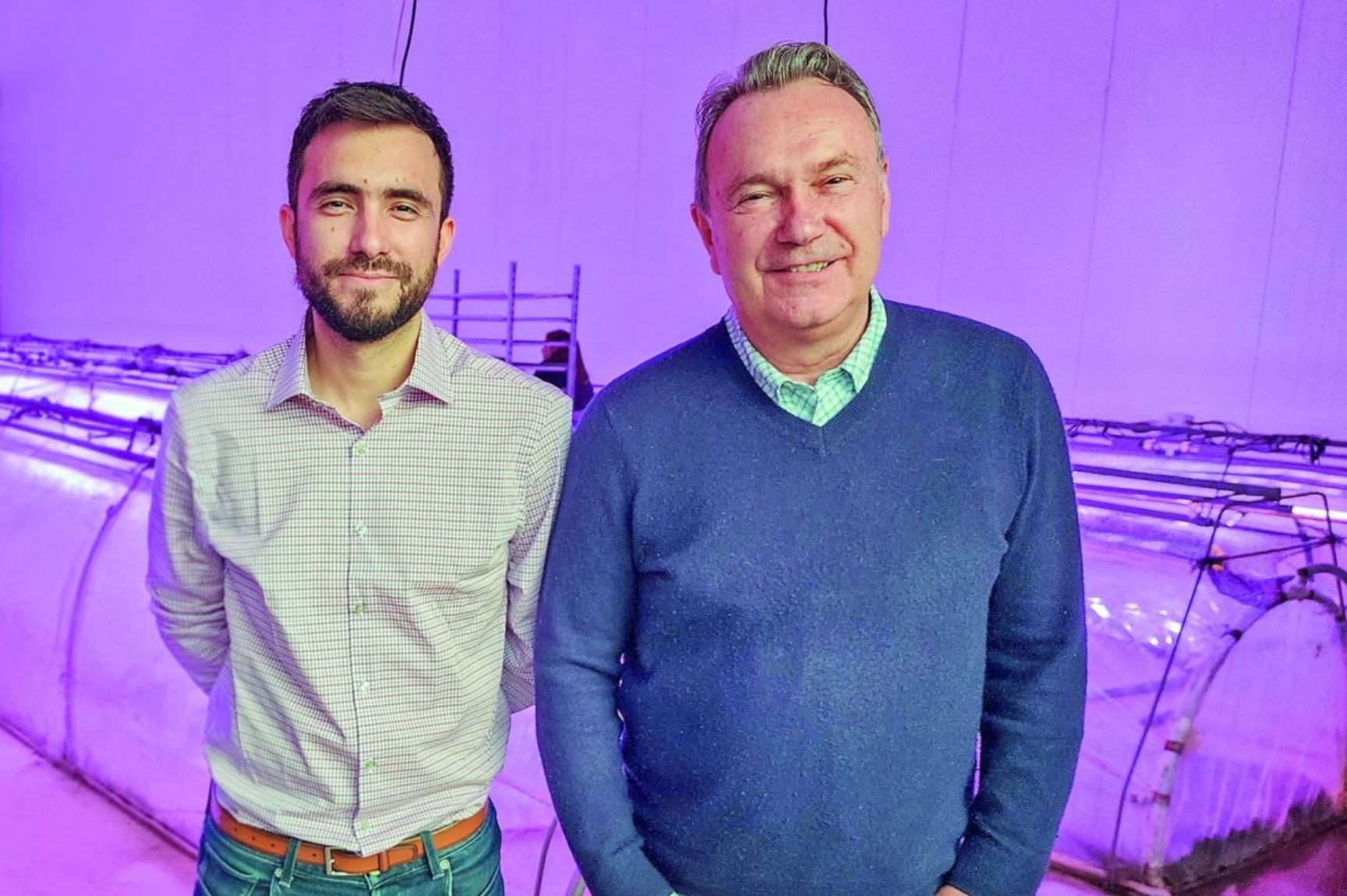
“The area has that typical ecosystem, with plenty of interesting opportunities for networking,” says Juan Ignacio Goycoolea Sone, CEO of the group and son of Gaspar Goycoolea Vial, the company’s Chairman, speaking over the phone.
The transaction — advised by Colliers and completed a few weeks ago for an undisclosed amount — marks a milestone for the Chilean group founded in the 1960s by Juan Sone Mizunuma, the son of Japanese immigrants. Today, Grupo Hijuelas is one of Latin America’s leading nurseries for berries and ornamental plants. Its move into the United States opens a new chapter in its international expansion through two new subsidiaries: Inversiones San Marcos LLC and Hijuelas Nursery LLC.
“Arriving in the United States means stepping up to another level and beginning to look at the world from a different market. We have traditionally looked at it from Chile, and now the idea is to position ourselves from the United States,” explains the company’s Chairman, seated beside his son.
This international expansion is not limited to the United States. At the end of August, Grupo Hijuelas opened a new nursery in Querétaro, Mexico, focused on berries. The goal is to turn both countries into strategic hubs for the group’s future growth.
The move follows the integration announced last year with Nueva Vid, a nursery linked to fruit grower Jorge Valenzuela. The partnership consolidated the region’s largest blueberry plant producer while expanding the company’s portfolio into major fruit crops such as table grapes, cherries and kiwifruit.
Hortifrut, Agroberries and the laboratory
- Juan Sone Mizunuma. Hijuelas. Those are the three key elements behind the origins of the group that today manages a network of companies and ranks among the world’s largest propagators of blueberry plants.
But there is more history behind those coordinates.
Sone, the son of a Japanese agronomist, founded a small indoor plant nursery that year in the town of Hijuelas, in Chile’s Valparaíso Region. The business grew gradually and only made a major leap forward in the early 2000s.
At that time, the entrepreneur divided the company between his two daughters, splitting the business. Gaspar Goycoolea, husband of Patricia Sone and an agricultural professional with experience in raspberry production, then joined the company.
Under his leadership, the group strengthened its fruit business and formed an alliance with Víctor Moller, founder of Hortifrut, for whom they began producing blueberry and raspberry varieties — a relationship that continues to this day.
That model helped establish Hijuelas as a key supplier of plants and as an important player in the expansion of Chile’s export fruit industry. From there, the company moved into new varieties and established partnerships with agricultural families such as the Vletters from the Netherlands; Jorge Mohr of Nefuen; and the Romero family of Agroberries, the world’s second-largest berry marketing company.
So, what does Hijuelas do?
Essentially, it is a nursery group that develops, produces and markets fruit and ornamental plants. In other words, it produces the plant material that later supplies major growers and exporters.
For this reason, Gaspar and Juan Ignacio Goycoolea say that research, science and technology are fundamental to the business.
At the heart of the company is its laboratory — internally known as the Research, Development and Innovation Center. There, teams work on in vitro propagation, plant health testing, genetic traceability, pollinizer combinations and varietal breeding programs.
This scientific work is complemented by field activities, including greenhouses and experimental orchards where developments originating in the laboratory are validated and fine-tuned.
A family business
At the office, Juan Ignacio Goycoolea calls his father “Gaspar.” Outside work, he simply calls him “Dad.”
“Outside the office, he is Dad, but here at work, he is Gaspar. Although most people generally call me GGV,” Gaspar says.
That is the formula the family has found to maintain the professional distance needed to manage a fully family-owned business.
Three years ago, the family reorganized its structure and Gaspar Goycoolea stepped down as CEO — a position he had held for 25 years — handing leadership over to his son Juan Ignacio, 34, an agricultural engineer, MBA graduate and former vice president of football club San Luis de Quillota, where he had also played in the youth academy.
Before becoming CEO, Juan Ignacio had led the group’s internationalization process.
His mother, Patricia Sone, heads the laboratory. The other children of Gaspar Goycoolea and Patricia Sone also lead different areas of the business: Gaspar Andrés is responsible for technology, while Vicente, based in Osorno, leads the ornamental plant business.
Within the family, their connection with agriculture is almost seen as destiny: both surnames of the company’s founder are linked to the land. Sone means “strong root,” while Mizunuma means “source of water.”
Today, the group employs more than 1,200 people in Chile and another 400 abroad. It produces more than 45 million plants annually worldwide and operates more than 1,000 hectares across different countries.
Europe and Africa
Work will begin next week to adapt one of the newly acquired U.S. properties for the company’s own operations.
Both executives explain that the acquisition was completed through an internal financial structure.
“There are partnerships with several families, and all capital raising is done through the company’s own structure,” says Gaspar.
Juan Ignacio adds: “It is not backed by an investment fund. It is 100% Grupo Hijuelas. We develop a financing plan using a mix of our own capital and debt.”
The objective of entering the U.S. market is to strengthen the group’s scientific capabilities, as well as its production and commercial operations.
“Today, a large part of our innovation platform is based in Hijuelas. The idea behind these two buildings in the United States is to complement that innovation platform, create synergies between both locations, strengthen partnerships with universities and begin developing projects with a greater technological component.”
“And we are going to do the same in Europe,” Gaspar adds.
Indeed, the group is opening new operations in Europe and Africa, specifically in France, Morocco and South Africa. The first teams have already arrived at those locations.
“Chile clearly has a problem when it comes to investment”
From a production standpoint, the initial focus in the United States will be on berry plants.
“Many of our clients and major companies have expanded into other territories, and the United States is a market we need to supply. So we are bringing our genetics portfolio into the country. After that will come new developments in emerging crops, such as in vitro avocado propagation and other fruit species that are also becoming part of this platform,” explains Juan Ignacio.
The group’s main soil-based production development, however, will continue to take place in countries such as Mexico and Peru.
“The United States is important because of its domestic market and its innovation ecosystem. It allows us to play in the major leagues. Being there will give us a different perspective and enable us to accelerate many processes.”
The company is still in the process of structuring its NAM — North America — management division, which includes the United States and Mexico and is currently coordinated from Hijuelas, where the group’s headquarters remain.
“We still have around five or six months ahead of us before the project can be fully implemented,” says the CEO.
He adds:
“Our vision is to become the best platform for agricultural development with a global presence. That is why we have been pursuing this internationalization strategy: to reach different markets and diversify our plant propagation capabilities across different territories.
“And logically, for us, the United States is a major and strategic market, where a significant part of both current and future agricultural innovation will originate.”
Are you still optimistic about doing business in Chile, or are you increasingly looking abroad?
Gaspar Goycoolea:
“Today, Chile clearly has an investment problem because there are no clear rules and there is a lack of alignment between public and private policy.
“Peru is very different, and in that sense it creates a healthy sense of envy when you see what they are doing. They may have had around seven presidents in prison, but the public and private sectors work together and develop the entire country. It is impressive.
“You would not believe how much they invite us and encourage us to invest there. Here in Chile, instead, you face obstacles.
“Chile needs clear, long-term investment policies, particularly for the fruit industry, and that is an area where we are falling behind.”
Share article:


.svg)
Related
.jpg)